
 USD
USD GBP
GBP
 EUR
EUR









First section of wooden board
The application of wood panels in office chairs can be divided into two types: integrated panels and split panels. Integrated panels are also known as one-piece molded panels. Split panels are panels with separate seats and backrests, and can be double-curved (two types of curvature), single-curved (smooth bend), or have a radius of 900R, etc.
Characteristics of wood planks:
Molded plywood: Non-planar plywood formed by assembling glued veneers into a blank according to certain technical requirements and then molding it. Composite plywood: Non-planar plywood made by gluing and molding non-timber or veneer materials as the core board and covering it with veneer or other sheet materials.
Curved surface: A smooth and continuous surface that deviates from the horizontal plane. Curved boards are made by gluing layers of wood veneer together and then hot-pressing them under high temperature and pressure. For the same thickness, the thinner the veneer, the better the strength! Typically, curved boards are made by hot-pressing 1.3mm layers of wood together; solid wood is natural timber, while curved wood is less prone to warping and is more suitable for use.
Currently, the market and customers have higher requirements, and limits are placed on harmful substances in wooden furniture, mainly formaldehyde content (due to the quality of the glue), preservatives, heavy metals, and flammability. Our company primarily uses bentwood boards, which have formaldehyde content issues (potentially causing a chronic illness).
Key points of inspection:
Strength requirements: A wood panel strength testing machine is required, with a pressure of 3 atmospheres and a load of 147 kg, maintaining 3 degrees of deformation, and ensuring proper cutting and dimensional accuracy! The one-piece panels are divided into sections to ensure that chairs from the same batch maintain the same angle!
Second section of handrail
Handrails can be categorized by material as follows: PP, PU, iron, aluminum alloy, iron (electroplated, painted), and wooden handrails (bent wood, solid wood).
Features of various handrails:
PP handrail: Hard plastic, impact resistant, pressure >136kg
PU handrails: cast in shape, the shape is determined by the mold, or extruded and contain iron parts.
Bentwood handrails: High waste, many processes, high cost, and susceptible to weather conditions. However, they are aesthetically pleasing, high-end, and popular in the American market.
Handrails are functionally categorized into fixed, lifting, rotating (panel rotation, support rotation), lifting + rotating, and fixed + rotating handrails. Key inspection points: dimensions (refer to drawings), surface integrity, and whether each part functions properly. From an application perspective, all handrails are further divided into two-point (connecting seat and backrest) and stand-alone types.
Section 3 Organization
KG: With foot rings, fixed plate + gas spring + lifting mechanism; TG: Fixed base with basic tilt + gas spring (lifting + tilt + single locking).
BG: Fixed chassis + pneumatic rod (lifting) STG: Stepless synchronous tilting mechanism + pneumatic rod (lifting + tilting + five-stage locking, simple STG T21MC.SN-6835 for split plates)
KTG: Front-mounted tilt mechanism + gas spring (hexagonal spring steel, lifting + tilt + single locking, with two handles) DTG: Two-stage tilt mechanism + gas spring (T22A: seat divided into two tilt sections)
ATG: Front-mounted tilt mechanism with five-stage synchronous locking. (T47N, KM9, for one-piece boards) With technological exchange and development, the mechanism has evolved from the original fixed chassis to a tilt mechanism (TG). The TG mechanism is the most basic synchronous tilt and rotation mechanism. Although it has basic synchronous tilt function, because the rotation support point for tilting is in the middle of the seat, the thigh muscles are easily compressed when tilting, making it not an ideal mechanism.
The KTG mechanism is a cantilever tilt mechanism, also known as the Knee tilt. It moves the pivot point for tilting to the area closest to the knee, significantly reducing pressure on the thigh muscles during tilting. However, because the seat and backrest tilt simultaneously, the seat and backrest angles are fixed, resulting in a relatively fixed sitting posture. This means the groin area cannot fully extend during tilting. To address this issue, the STG mechanism was developed.
The STG mechanism is a stepless (usually five-stage) synchronous tilt mechanism, also known as Synchronous Tilting. This mechanism effectively addresses the shortcomings of TG and KTG type mechanisms. By adjusting the chair, it allows various parts of the body to stretch comfortably, alleviating fatigue when sitting at a desk.
The difference between KTG and STG mechanisms: Both mechanisms feature synchronized pitch, but the only difference is that STG can be locked in segments, allowing for arbitrary locking within the pitch angle range; it is a stepless or fixed-angle locking mechanism. KTG, however, does not have this function.
Features of the Synchronous Tilting Mechanism: The synchronous tilting mechanism is a highly human-centered and conceptually advanced feature. It breaks away from the discomfort caused by traditional tilting mechanisms after prolonged sitting. The seat completely responds to the body's tilting movements, providing users with synchronized health and comfort. With ordinary chairs, when reclining, both legs simultaneously rise, resulting in the feet dangling in the air. This creates downward pressure on the legs, leading to poor blood circulation and tense thigh muscles. The synchronous tilting mechanism operates with the seat and backrest operating at a 1:2:5 angle. When the chair back tilts, the seat slightly rises, allowing the feet to rest lightly on it, freely stretching the tired body and eliminating the phenomenon of clothing being pulled up behind the back.
Components related to the mechanism: What is the relationship between mechanisms such as STG and KTG? STG is always a separate unit, and the backrest tilt mechanism is also separate; KTG is not necessarily separate, but the seat and backrest must be at a fixed angle. What determines the L-bar setting? The L-bar is the back steel plate. The L-bar is set according to the mechanism and chair angle. Different gas springs and mechanisms will directly affect the seat height of the chair. Inspection focus: Dedicated inspection fixtures (function, taper), dimensions, surface, sound.
Section 4 air pressure bar
The main function of a gas spring is to adjust the height of a chair. It consists of two parts: an inner core and an outer tube. The outer tube is available in two finishes: electroplating and baking paint. It's important to know how to check the dimensions (e.g., 230mm x 10mm). The gas spring must be paired with the corresponding chair legs, generally at least 2cm off the ground. Gas springs can be categorized by origin: Taiwanese (MDI), German (Suspa), and Korean (SHS). Domestically produced gas springs are less commonly used. Angle teeth: a rotary height adjustment mechanism that can replace a gas spring, but is less expensive and less frequently used. Terminology: Stroke: refers to the maximum distance the inner core can be raised or lowered. Inner core grade: refers to a surface treatment method that increases the inner core wall thickness and lightens the surface, thereby strengthening the gas spring (a higher grade indicates higher inner core strength and greater abrasion resistance). Taper: 1 26′16″
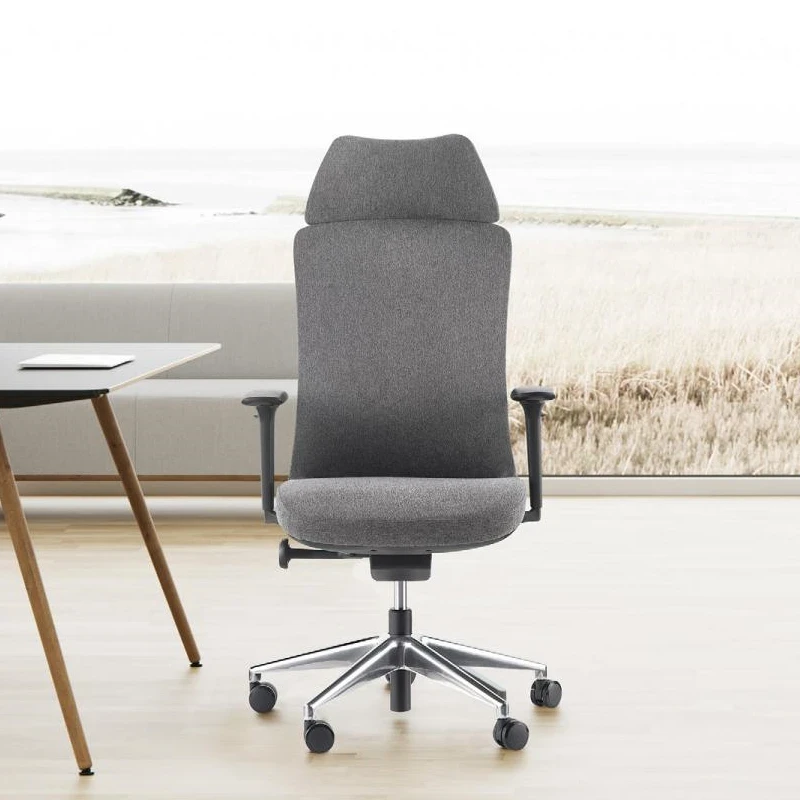
The fifth category can be divided into two types based on shape: five-star feet and arched feet.
Classified by size (radius, mm): Nylon chair legs (mainly nylon + 30% fiber) can be divided into: 270, 280, 300, 320, 350. Aluminum alloy chair legs can be divided into: 300, 320, 350. Iron chair legs can be divided into: 300, 320, 350.
Aluminum alloy chair legs are manufactured through the following steps: die casting, polishing, and surface treatment (electroplating, oxidation, and baking paint). Iron tubing legs are formed by bending, welding, or stamping iron tubing. Iron chair legs can also be painted. Both baking paint and electroplating involve initial pickling, a full treatment to remove surface impurities and balance the surface pH to 7 (a middle value; higher indicates acidity, lower indicates alkalinity). The paint is epoxy resin, generally available in liquid and powder forms. Liquid paint is applied using electroplating (a surface treatment method similar to electroplating), while powder paint is applied by spraying and then baking in an oven. Paint peeling is common, so electroplating is generally used for chair legs.
The sixth section discusses chair wheels, which come in two specifications: fixed wheels and movable wheels. Movable wheels can be further divided into medium-plate wheels (50, 60, 75), ordinary wheels (50), and brake wheels. Chair wheels can be categorized by material: PP chair wheels, PU chair wheels, anti-static chair wheels, nylon wheels, etc. Nylon wheels are made of PP with added fiberglass (glass fiber), which is harder than PP and does not expand or contract with temperature changes like PP. PU wheels are essentially nylon with an outer layer of PU. Generally, nylon wheels are used on soft surfaces (such as carpets), while PU wheels are used on hard surfaces such as wooden floors (because PU wheels are less likely to damage smooth surfaces and will not generate much friction or noise with wooden floors). Conversely, using PU wheels on soft surfaces will result in too much resistance and make sliding difficult. Using nylon wheels on hard surfaces would be too slippery. Price ratio: PU wheels/Nylon wheels = 3/1. The most common chair wheel diameter is 50MM. Depending on the chair design and customer requirements, our company will also use special sizes with diameters of 60MM and 75MM.
Section 7 cowhide
I. Currently used leathers include: cowhide, buffalo hide, pigskin, and various colored leathers. II. Based on leather layers, leather is further divided into top-grain leather and split leather. Top-grain leather includes full-grain leather, corrected-grain leather, and embossed leather; split leather is further divided into pig split leather and cow split leather. Top-grain leather: The outermost layer of leather, with good flexibility, elasticity, and a soft, smooth feel, is called top-grain leather. Split leather: The second layer of leather below the top layer is collectively called split leather. Removing the coarser, better-woven top layer, split leather has relatively poor flexibility and elasticity, and is prone to cracking. Therefore, thicker split leather is usually chosen for chairs. These reasons make split leather unsuitable for upholstered chairs; its skin structure is damaged, and its elasticity is weak, making it prone to cracking under heavy pressure. Therefore, we usually use the method of sewing the top layer together to make the chair seat, which is also more cost-effective.
Made from raw hides, this leather retains its natural state on the surface, with a thin coating that showcases the natural beauty of the animal hide's grain. It is not only durable but also highly breathable. Repair leather: This is made by lightly sanding the surface with a grinder, then applying a finish and pressing on corresponding patterns. Essentially, it's a "cosmetic" treatment of damaged or rough natural leather, almost completely losing its original surface texture. Embossed leather: This is made by heating and pressing various patterns onto the leather surface using patterned plates (aluminum or copper) to create a specific style of leather. Currently popular patterns on the market include "Lychee Grain (Small Lychee Grain, Large Lychee Grain)" and "Mercedes Grain," which are also among the leathers most frequently used by our company.
Split leather: In the leather-making process, to improve utilization, it is usually obtained by splitting thick hides using a splitting machine, typically into two or more layers. The first layer of split leather, after surface finishing, is used to manufacture high-grade leather. The second layer and below lack surface texture and are less aesthetically pleasing and practical than the first layer. It has poor abrasion resistance and is the cheapest type of leather. PU transfer coating: Its reverse side is the split leather, with a layer of PU resin (polyurethane) coated on the surface. A layer of PU is added to the split leather using a PU transfer production method, giving it the excellent properties of the first layer. It is cheaper and has a higher utilization rate.
III. How to Distinguish: The main methods of differentiation are visual inspection, touch, and smell (experience). Visual inspection of the texture: Top-grain leather has tightly connected fiber layers, possessing excellent strength, elasticity, and workability. Second-layer leather, on the other hand, has only a loose fiber structure and is less strong. Touch: Top-grain leather feels comfortable, soft, and elastic; second-layer leather feels harder and rougher. Smell: This mainly depends on the type of leather and relies entirely on experience. Key inspection points: Texture, elasticity, abrasion resistance, colorfastness, smell, touch, thickness, and finally, size. Related content: The cowhide manufacturing process first uses cold water to remove ash, then hot water, each for approximately 2-3 hours. Ammonium chloride is used for softening, for approximately 3 hours. A softener is added, and the mixture is heated and run in a machine for 4 hours to create a blue board. A paste is applied, and the leather is dried (repeated twice). Embossing and texturing are then done. The leather is then softened again, stretched, sprayed with paste, and finally coated with varnish, color fixative, and a hand feel agent. The leather is then measured and packaged.